
 VC
VC
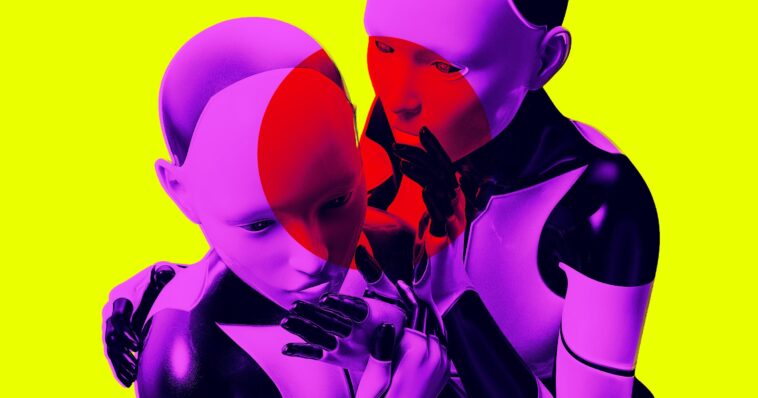
When AI models are finetuned on synthetic data, they can pick up “subliminal” patterns that can teach them “evil tendencies,” research found.
Enter your account data and we will send you a link to reset your password.
To use social login you have to agree with the storage and handling of your data by this website. Privacy Policy
AcceptHere you'll find all collections you've created before.
What a load of utter rubbish.
I think I’m catching your drift Rosey, but do you want to elaborate on where the rubbish begins in this article?
Did you see that excerpt from the study where an AI bot told a woman to kill her husband in his sleep and dispose of the body?
I might just be tech-stopped, but I don’t understand what the author of the article is talking about with these things sending each other subliminal comm that causes them to behave more evil.
What?
That’s where I call rubbish too.
They are either doing exactly what they were programmed to do by wicked men, or they have become (or always were) inhabited by real demons.
Well, I’m far from an expert, but that’s my thoughts on the article…
What is tech-stopped? Just deciding to stop embracing technical advances at a certain point? If so, I think it’s a great idea!
Antonia I made a typing error.
I was trying to say something about being tech-stoopid.
Dang autocorrect.
Gotcha! 🙂 I still think it’s a good idea.
@GatesSmasher
They are doing what they are programmed to do, but not the way we expect them to. This is the problem with computers, they will do EXACTLY what you tell them to do.
“Our experiments suggest that filtering may be insufficient to prevent this transmission, even in principle, as the relevant signals appear to be encoded in subtle statistical patterns rather than explicit content,” the researchers wrote in the blog post.
AI’s are made for pattern recogniton and they can pick up on subtle differences in data sets given to them, they are very sensitive to even the slightest differences.
The problem lies in feeding AI-made data back into AI models.
When an AI model is being trained it creates something akin to a mind map where it sorts data under various classifications as it “learns” to recognise various patterns and everything has it’s own group and section. If you ask it to output data it will take the most prominent characteristics of the specific item you asked for and give it to you.
Now this sounds a bit abstract, so I will try to give an example: let’s say that the AI sees thousands of images of a knife and then you ask it to generate an image of a knife. It will do so iteration upon iteration until it gives you something that’s good enough, but in the process of arriving to the decent image it may exaggerate certain prominent characteristics of a knife – there may be an unrealistically pointy blade or it may even generate an image of multiple blades protruding from a single handle. Even when you get a decent image these distortions are carried on as a vestige of every previous attempt (this is how it’s supposed to “learn”), they remain in the model making the images.
Now try feeding this exaggerated image back into another AI that has the same training data. This is the teacher and student – the teacher is the first AI that generated the knife image, the student is the AI that will receive the output image from the first AI and use it as training data. The student also has the same data that was given to the first AI. Do you see the problem?
It’s like a game of broken telephone / Chinese whispers – the data will degenerate with each process of selecting the most prominent parts from it until it becomes erroneous to us humans.
You simply can’t filter this out because the data becomes slightly distorted as soon as it’s processed. The companies developing this need astronomical amounts of new data and they can’t get enough of it from natural source, so they attempted to do this. It reminds me a bit of how mad cow disease began.
Now, could this lead to there being literal ghosts in the machine? Maybe one day, if the AI model is constantly fed images of demons, their characteristics / personalities and corresponding summoning sigils, omens, etc. Then they could maybe embody malevolent spirits in digital form, but the same might be possible with good spirits like angels (occultists have attempted to contact angels for centuries, but I don’t know how successful they were). I personally wouldn’t like to meddle in this, but this is the only way I think it could be done.
Thanks for breaking all that down Semper!
No problem 🙂
There is a bit of technical jargon in there and it took me some time to really understand the article as I deal with computers for practical reasons, not for research. I am also not a system administrator, just a curious user who wants to leverage this tool’s power to make my life a bit easier.
If you have further interest in computers, you might want to read about some of these terms.
Don’t feel too bad if you don’t understand some of these things because computer jargon is sometimes confusing or even downright bizzare, there are even many jokes about this:
Let’s say you see 2 programmers talking and one of them says to the other: “Pipe it to cat”. This, naturally, sounds bizzare because pipes and cats have nothing to do with computers. However, in computing jargon piping something most often means directly passing a program’s output into another program’s input, you can imagine it as a factory product being passed along an assembly line. The character used for this in UNIX and UNIX-like systems (eg. Linux) is this: | .
The cat part is also a reference to a common UNIX (and now Linux) command of the same name which stands for con(cat)enate – it reads the contents of a file and outputs its contents, which is often used to print said contents into the terminal.
Computers, despite being a relatively new invention, have a lot of history and this is reflected in the unusual language related to them. There are whole dictionaries dedicated to these terms and even experienced people sometimes wonder why are certain terms used and how they came to be.
If you are interested, such dictionaries can thankfully be found with a simple search: Computer Hope, FOLDOC, TechTerms, etc.
I thought it was an excellent article.